
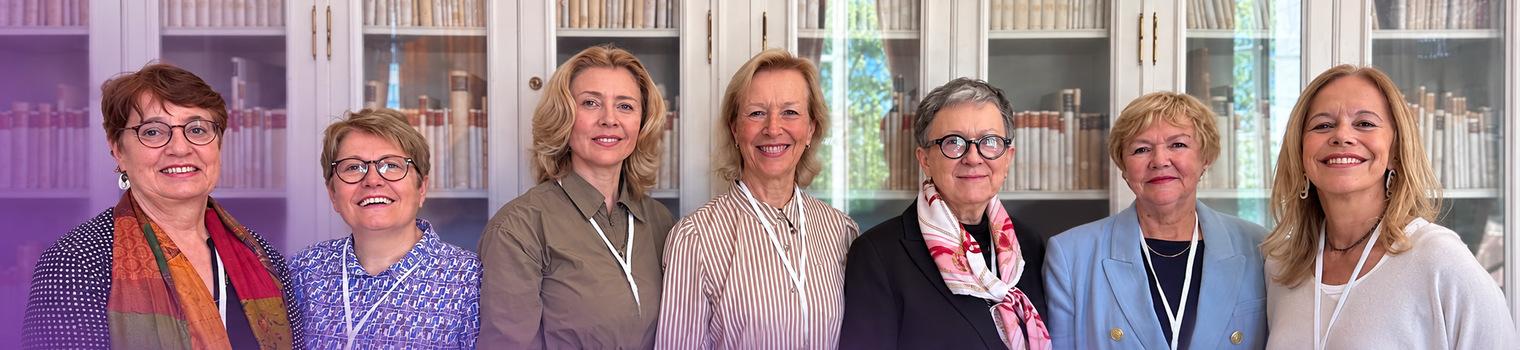
EWORA’s Inauguration Ceremony was held at the Fondation Universitaire (University Foundation) in Brussels, marking an important moment for women’s leadership in European higher education and research.
The gathering examined the challenges and opportunities surrounding women’s empowerment, participation and leadership in academia. It brought together current and former women academic leaders, representatives of major higher education networks, gender experts and diplomats from across Europe.
Carlos Moedas delivered the keynote address, “Equality isn’t just a women’s issue, it’s a human one.” Congratulating EWORA on its establishment, he encouraged the association to use the power of its network to make women’s voices heard in research policymaking.
UN Women Regional Director for Europe and Central Asia Ingibjörg Sólrún Gísladóttir delivered a keynote speech highlighting the need to invest in women’s education and participation in leadership. Věra Jourová, European Commissioner for Justice, Consumers and Gender Equality, contributed a video message.
Chaired by Professor Pierre de Maret, Honorary Rector of the Université Libre de Bruxelles, the panel brought together Timo Ranta, Finland’s Ambassador to Belgium, and Selim Yenel, Ambassador and Permanent Representative of Türkiye to the European Union. They discussed gender equality in their respective national contexts.
Chaired by Professor Rolf Tarrach, President of the European University Association, the panel featured EWORA Board Members Gülsün Sağlamer, Helena Nazaré, Ursula Nelles, Christina Ullenius and Carmen Fenoll. They shared their experiences as women leaders in academia and their aspirations for EWORA’s future.
Chaired by Viviane Willis-Mazzichi, Head of the Gender Sector at the European Commission’s Directorate-General for Research and Innovation, the final panel included EWORA Scientific Advisory Board Members Liisa Husu, Inés Sánchez de Madariaga and Mine G. Tan. Their closing reflections highlighted EWORA’s role in empowering women and transforming the culture and structures of academic institutions.
